ESP32-S3 Keychain Camera
A pocket-sized WiFi-transfer keychain camera built on a Seeed XIAO ESP32-S3 Sense (OV3660 sensor), 16 GB microSD, and a 200 mAh Li-Po in a custom 3D-printed enclosure. One-button operation: tap to snap, later dump photos to a phone over WiFi — no app, no cable.
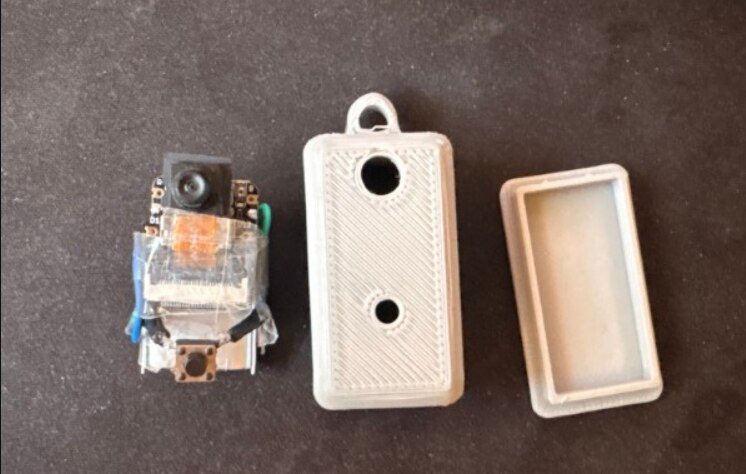
The engineering interest lives at the seams: an OV3660 camera driver that has to come up cleanly on every wake, deep-sleep bookkeeping tight enough that a 200 mAh cell lasts weeks of casual use, a WiFi access-point + HTTP server that serves photos straight from the SD card to a phone browser without any app, and an enclosure printed to hold the whole thing at keychain scale.
Built around one button
A single-button UX for a device that doesn't have room for anything else. Press duration disambiguates every mode.
| Action | What it does |
|---|---|
| Single tap | Wakes the camera, captures a photo, saves as YYYY-MM-DD_HH-MM-SS.jpg, returns to deep sleep. Filenames sort chronologically. |
| Hold 3 seconds | Enters WiFi transfer mode — broadcasts an access point. Connect from your phone, then open a browser to 192.168.4.1 for the photo gallery. |
| Tap a photo (WiFi mode) | Opens a lightbox — long-press the image to save it to the phone's camera roll. |
| Single tap (WiFi mode) | Exits WiFi mode, returns to normal sleep/capture. |
| Idle 2 minutes (WiFi mode) | Auto-exits back to sleep to save battery. |
Bill of materials
End to end
Firmware
- Wake-from-deep-sleep bootpath: bring up camera → capture → JPEG-encode → write to SD → sleep. Every step measured for latency to keep the "tap to shot" window tight.
- State machine for the three modes (sleep, capture, WiFi transfer) driven by button-press duration.
- Filesystem hygiene: timestamped filenames, safe unmount on sleep entry.
Web UI
- ESP32 acts as a WiFi AP + HTTP server, streaming JPEGs off the SD card to the phone's browser.
- Themed gallery grid with a lightbox view — long-press to save to the camera roll, no app install required.
- Auto-exit timer so the AP doesn't burn battery if the user forgets to close it.
Power
- Deep sleep on a 200 mAh cell — the design point that makes a keychain camera possible.
- The button is wired to a wake-capable GPIO, so the MCU is fully off between shots.
Enclosure
- Two-piece press-fit body in SolidWorks; camera aperture, button dome, SD access, and charge-port cutout in the right places.
- Printed and iterated on a home FDM; final fit tuned by shaving 0.15 mm off the lid press fit.
Small builds, real skills
Deep-sleep bookkeeping, camera bring-up, filesystem I/O, WiFi networking, HTTP + a web UI, and a printed enclosure that has to actually fit the parts. Every one of those maps to a piece of embedded work you'd do on a shipping product — just at a scale that fits on a keychain.